

Some pilgrimages explore history, and others explore the dynamics of life. Anyone who knows me knows that I almost always choose the fastest route. On my way home from a friend’s wedding, I chose the slow road instead.
The slow road led first to a tree and then to a bridge.
There is almost nothing between Monroeville and Selma: fields, forests, and an occasional country store that seems to have stood at the crossroads forever. The road itself invites attention, reflection, discomfort, and those pregnant pauses that are increasingly rare in modern life.
The emptiness also gave me time to think. Somewhere along that lonely road, I called my friend Harold. It was the first time we had spoken since his wife, Clodagh, died, and we talked for a while as the fields and forests passed by my windshield. Somewhere along that road, history gave way to grief and friendship.
I have loved To Kill a Mockingbird for most of my life. Outside of Scripture and theology, no book has had a greater influence on my moral imagination. Harper Lee was my generation’s Plato, and she was certainly mine.
The town is proud of Harper Lee and Truman Capote, and rightly so, but it remains what it has always been—an ordinary Southern town.
Perhaps that is fitting. The extraordinary so often emerges from ordinary places.
It was hot as Hades, the kind of Alabama heat that settles onto your shoulders and makes you wonder how anyone functioned before air conditioning. The smell of cut grass, perspiration, and humidity filled the square. Inside the old courthouse, the floorboards creaked beneath my feet, and suddenly the world of Scout and Jem became tangible. I could feel the textures of that time and place.
Standing in the courtroom, I found myself looking not at the judge’s bench or where Atticus would have stood, but at the balcony. My first thought was of Tom’s wife sitting there and looking down into a courtroom where her husband’s fate was being decided by people who held absolute authority over his life.
The crux of Maycomb was always the balcony. That is where Tom Robinson’s family and Reverend Sykes sat as they sought to make sense where none was possible. It is the place from which the powerless witnessed proceedings orchestrated by people who held authority over their lives—lives for which they did not care.
As I stood there, scenes from the movie came alive with an almost lived memory. I could see Tom, and I could see his family, and I could hear Reverend Sykes saying, “Miss Jean Louise, stand up. Your father’s passin’.”
The children are everywhere in Monroeville. Scout, Jem, and Dill are depicted repeatedly. Their statues stand beneath a tree but not the tree, and their likenesses appear on murals. Harper Lee is remembered well, too. Tom and Boo, however, are harder to find, and that absence stayed with me.
The tree itself no longer stands. What remains is a weathered section of trunk, preserved beneath glass like a relic.
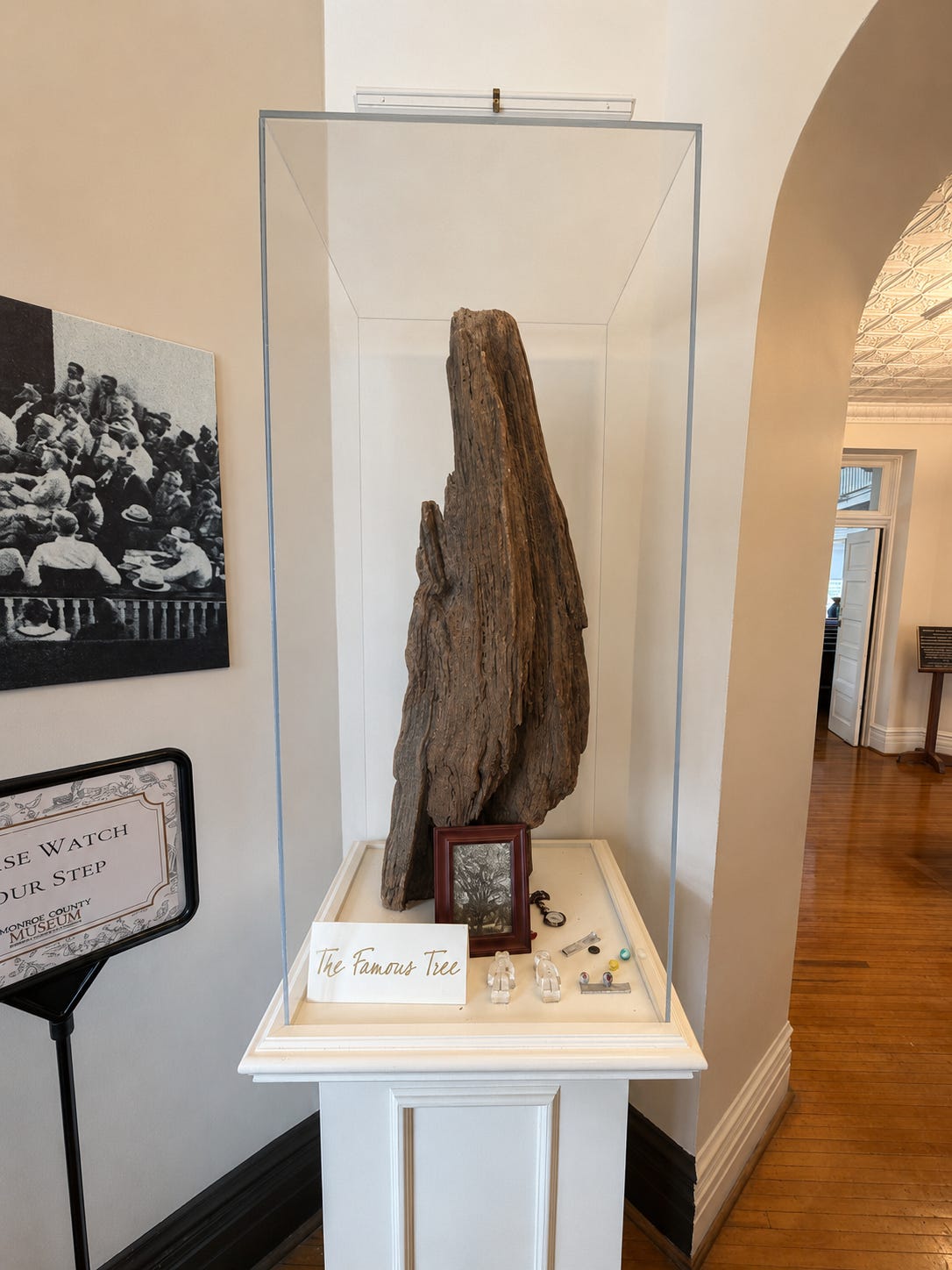
Twelve-year-old me would have wanted to throw a ball with Jem and climb the tree. The child wanted to climb the tree; the man wanted to sit in the balcony.
I left Monroeville carrying the world of Scout and Jem. The balcony came too.
Then I drove to Selma.
There is almost nothing between the two places except lonely roads and country stores, and the emptiness gave me more time to think. I wondered how many times Harper Lee had made that journey in her lifetime. Then it occurred to me that, in another sense, Scout Finch had made that journey every time a reader carried Maycomb’s questions into the real world.
I entered Selma by unexpectedly crossing the Edmund Pettus Bridge. Only after I had crossed did I fully appreciate what had happened. I had entered the city in the same direction that the marchers had been driven back on Bloody Sunday. Of course, I was free to turn around at any time. They were not.
It was every bit as hot in Selma as it had been in Monroeville, but the asphalt and concrete made it feel warmer still.
The first thing I noticed was the name: Edmund Pettus Bridge, emblazoned in large black letters. Named for a Confederate general and Grand Dragon of the Ku Klux Klan, the bridge seemed determined not to let history become too tidy.
The second thing I noticed was the incline. As an engineer, I immediately saw the grade. The bridge rises just enough to conceal what lies beyond its crest.
I was alone except for the occasional car crossing the bridge.
I parked and walked back toward the bridge, but I did not walk across it. I remained on the Selma side, convicted by time and place.
The blood of Selma was real. I found myself thinking about James Reeb, the Unitarian minister who came to Selma because conscience demanded it and who was beaten to death for being there.
That bridge is holy ground. Some places invite us to enter them. Others ask us to remove our shoes. This is barefoot ground.
Monroeville gives us the lived memory of a story. Selma gives us the lived memory of sacrifice.
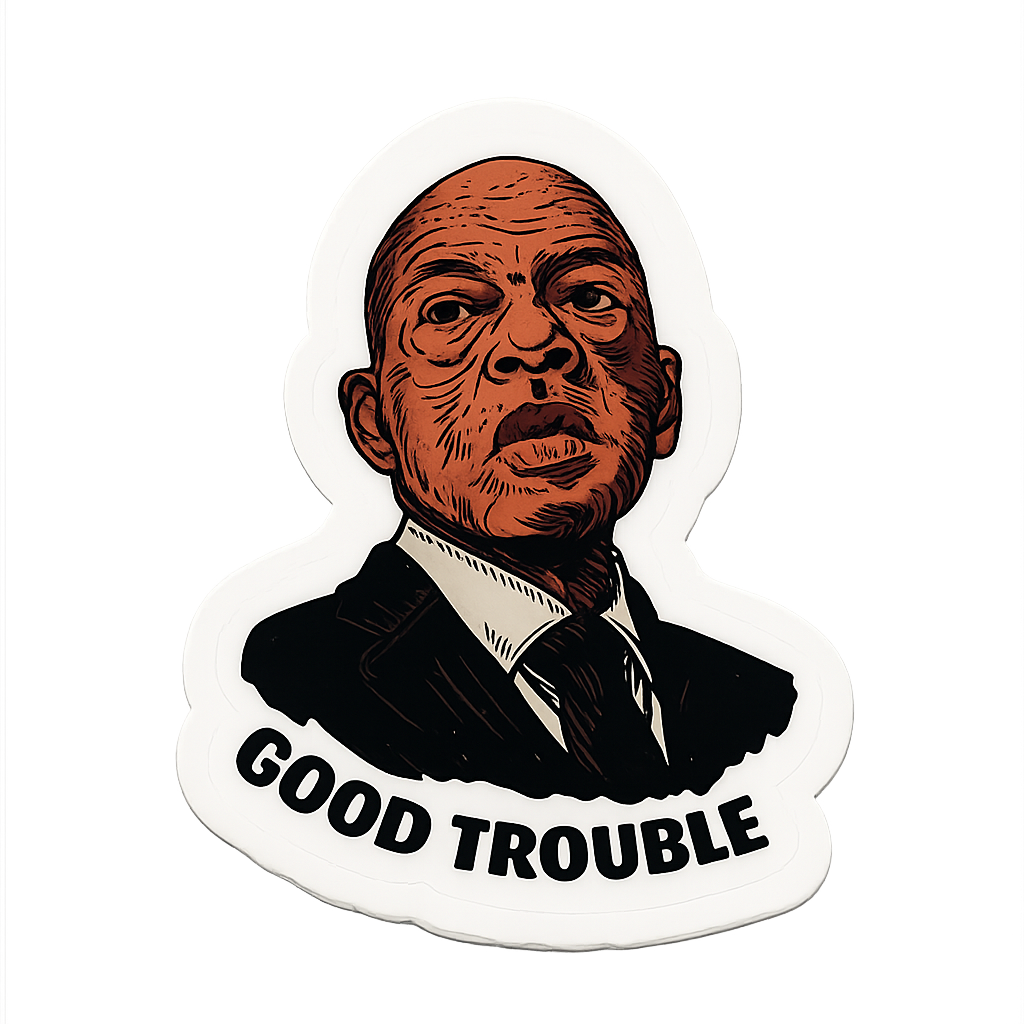
I bought two things at the visitor center before I left: stickers for the stamp to go in my National Park passport, which I’d left at home, and a John Lewis Good Trouble sticker. The sticker was not really a souvenir; it was a question.
What good trouble is required now?
I found myself thinking about two people who have shaped my moral imagination in very different ways—Harper Lee and John Lewis. I thought about my grandmother, who helped everyone who crossed the threshold of her country store while still carrying some of the prejudices of her era. I thought about a family member who likely stood at Ole Miss when James Meredith entered and not in a good way.
I thought about myself. I often wonder whether I would see the world in the same way had I been born in a different era. Would I have been a good Methodist, or would I have beaten Tom? I hope I know the answer, but history is filled with decent, respectable, churchgoing people who answered that question poorly and chose a different path.
I am part Jem, part Boo, and part Dill. When I grew up, however, I was mostly Atticus, with all his impurities. I have spent much of my life trying to shed the layers that obscure discernment, and I refuse to accept that anyone is less than me because of how their lineage was formed.
Somewhere on the road home, another question emerged: will the balcony hold?
I came home by way of Monroeville and Selma. The day itself was peaceful, but my spirit was not. I left Monroeville carrying the world of Scout and Jem, and I left Selma with the acknowledgment that we still have a great deal to overcome.
Somewhere between a tree in Monroeville and a bridge in Selma, a question took a seat in the balcony of Maycomb and refused to leave. I suspect it will ride home with me for a very long time.