
Water has followed me throughout my life.
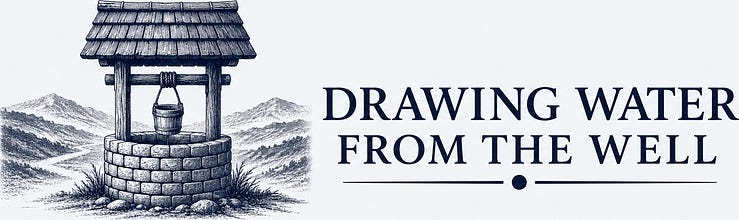
There was a well at my great-grandparents’ home. It sat partway down a long sloping front yard beneath a small roof, protected by a wooden cover. A bucket hung from a pulley. By the time I was born, no one depended upon it anymore. The house had plumbing. Water came from a faucet.
Yet the well remained.
As a child, I rarely thought about it. It was simply part of the landscape.
Only later did I begin to understand what it represented and how it had given life to generations of my family.
My great-grandparents depended upon that well. Every bucket of water for cooking, cleaning, bathing, and daily life came from that place. Long before faucets and water lines arrived, the well sustained them. It was not merely part of the property. It was part of their survival.
Every bucket had to be drawn.
Every bucket had to be carried.
A well is a reminder of dependence.
Modern life makes it easy to forget such things.
Water appears when we turn a handle. Electricity arrives when we flip a switch. Food waits for us on grocery shelves. Most of us spend very little time thinking about the things that sustain life until they become scarce.
Looking back, I realize that water continued to appear throughout my life.
Years later, while stationed on Diego Garcia, I lived on the third floor of a bachelor officers’ quarters with no elevator. Because the tap water could not be trusted, drinking water came from a large freshwater station outside the building. Every few days I hauled heavy five-gallon bottles up three flights of stairs.
It was exhausting.
At the time it seemed like little more than an inconvenience. Today I remember it differently.
The easiest water to reach was not the water I trusted to drink. That lesson extends far beyond water.
In Afghanistan, water arrived by convoy and was stored in large water buffalos scattered throughout the base. Most of us rarely thought about it. We simply trusted that it would be there when we needed it.
Only later did I appreciate how much effort, planning, and risk stood behind that trust.
Water was never simply water. It was life, carried from one place to another by people willing to bear the burden.
Over time I would discover that water is not the only thing people carry. Some things we carry give life. Others leave us searching for it.
Scripture repeatedly returns to water because water reveals something essential about life.
At Marah, Israel discovered that finding water and finding drinkable water are not the same thing. The people were thirsty, but the water they found was bitter. What appeared to be the answer could not satisfy their thirst.
Centuries later, Jesus sat beside Jacob’s well and met a woman who came looking for water. Like so many people, she arrived carrying a bucket and expecting an ordinary day. What she found instead was living water.
Jesus revealed that her deepest thirst had little to do with water. It was a thirst for belonging, grace, reconciliation, and God.
She arrived carrying a bucket.
She left carrying living water.
Over the years, I have found living water in many places.
Sometimes I have found it in the ordinary—a conversation with a friend, a quiet morning, or a moment of unexpected grace.
Sometimes I have found it in the extraordinary—in ancient churches, remote corners of the world, moments of profound beauty, seasons of deep suffering, and encounters that changed the way I understood myself, others, or God.
The deepest sources are not always obvious. Yet looking back, they are often the places that sustained me when other wells ran dry.
What I gradually came to understand is that these were not separate sources at all. They were different places where I encountered the same living water.
In Ezekiel’s vision, a river flowed from the presence of God. As it flowed, it became deeper. Wherever the river went, life followed. Trees flourished. Barren places became fertile. Even the waters of the Dead Sea were transformed.
The prophet’s vision suggests a profound truth: life follows the waters that nourish it.
Scripture ultimately points beyond wells, rivers, and streams to the God from whom life itself flows. We become dependent upon whatever sustains us.
And over time, what sustains us helps shape who we become. Perhaps that is why the image of the well has remained with me. The older I become, the more I notice how many people are thirsty. Not merely for water.
They are thirsty for belonging in a fragmented world. Thirsty for meaning amid constant activity.
Thirsty for peace in an age of outrage.
Thirsty for relationships deeper than transactions.
Thirsty for something sturdy enough to withstand life’s inevitable storms.
The world offers no shortage of distractions but surprisingly few things that truly satisfy.
We spend much of our lives drinking from shallow sources and wondering why our thirst remains. Not every well is trustworthy.
Some sources nourish us. Others merely occupy us. Some help us grow.
Others slowly deplete us.
We often mistake relief for renewal and distraction for sustenance.
What satisfies us in the moment is not always what sustains us over time. Wisdom often lies in learning the difference.
There is another image that often comes to mind. I imagine a person walking through a savannah.
The landscape changes slowly. Trees become fewer. Water sources become farther apart. The ground becomes drier. The changes are so gradual that they are barely noticed.
Then one day he looks around and realizes he is standing in a desert.
By the time he realizes where he is, he can no longer identify where he crossed the boundary. Life can be like that, existentially.
The responsibilities accumulate. The demands increase.
The years pass.
One day we discover that we have drifted farther from the sources that sustain us than we ever intended.
The desert rarely announces its arrival. It simply appears.
The lesson of the desert is not merely that water is scarce.
It is that the quality of the water matters.
When water is abundant, we rarely think about its source.
When the landscape becomes harsh and the journey becomes difficult, suddenly the source matters very much.
Deep sources matter.
Trustworthy sources matter.
Life-giving sources matter.
Because sooner or later, every life encounters a wilderness. The savannah slowly becomes desert.
The landscape grows dry. The easy sources fail.
And in those moments we discover what has truly sustained us all along.
The old well at my great-grandparents’ home taught a lesson it took me years to understand. Not every well is trustworthy.
Not every source that promises life can actually sustain it. But where living water is found, life follows.
Over the years I have found living water in many places. Yet beneath them all flowed the same river.
The challenge is not simply finding a well.
The challenge is learning to draw from deep sources before the savannah becomes desert. Every bucket still has to be drawn.
Every bucket still has to be carried.